
Litovsk: All We Have Left Is to Explore the Ruins of Capitalism
French post-punk band Litovsk released L’Aventure, and we talked about class anger, the changing face of Brest, and keeping things modest and local.

Happy Samhain, or whatever you call it! This time of year is when we hear so much new music. For genres that have always played with bleakness, darkness, death, and the occult, it makes sense that so many records come out around this particular pagan holiday. So I’d already prepared myself for tons of requests to cover new releases, but while I was expecting to choose among some metallic, evil-sounding hardcore, it was a huge surprise to have the opportunity to premiere the new LP from one of my favorite post-punk bands, Litovsk.
Their new album, L’Aventure, contains ten tracks released on beautifully packaged vinyl by Symphony of Destruction. Litovsk isn’t a band looking for publicity, and they don’t really feel comfortable with some wannabe music journalists praising their records. We did just that premiering their five-song release from Destructure a few years ago. The band felt a bit embarrassed, and it wasn’t the kind of article they were looking for.
So, this time I’ll just say that L’Aventure is a really good record that sounds just like Litovsk. If you’re already familiar with the band, you’ll love it. If this is your first encounter, you’ll definitely want to check out their past releases.
Litovsk also isn’t a band that gives interviews very often, especially online, so I feel privileged that they’ve agreed to do this one. And, of course, Litovsk is a punk band with political lyrics about fighting for the class interests of the dispossessed. The new record is no exception. All power to the people on the streets, in France and everywhere.

Litovsk has become a well known band in the DIY punk scene, but let’s start with a bit of your history. How did the band come together, and what does playing in a punk band give you that keeps you going as you get older?
Manu: Hey, thanks for interviewing us! Well, I dunno if we’re really well known, but it seems that our music has traveled a bit and reached people throughout the world. We’re grateful to the people who’ve helped us, especially DIY labels.
Clair, our bass player, started with the idea of doing a studio project based on the influence of bands he and the rest of us were listening to at the time, in 2013: The Estranged, Eagulls, Spectres, The Mob, A Touch of Hysteria, Zounds, and a bit of Blitz, Red Alert, etc. He gathered all of us together, and we weren’t meant to play live, as four of us were in Brest and Gwen, our drummer, was in Leipzig. Now it’s even more complicated, as we have Pablo, who lives in Toulouse, on second guitar, and I’m no longer in Brest, haha. But we managed to record a demo and thought, “Let’s play live,” and the rest is history.
I think I still play in bands because I still believe punk can be a tool for spreading a message, but also for releasing my anger and frustrations, for dealing with life. I also really love to tour and meet people all over the place, learning their history, their punk history, their culture… I love discovering new music, languages…
That’s the case for me, but I guess for all of us in the band, it’s also great to spend time doing Litovsk, as we don’t see each other much apart from the Brest lads.
Running an online zine, I’ve always had a complicated relationship with press releases, bands looking for publicity, streaming platforms, and social media. Litovsk, like many other DIY punk bands from France, seems to have consciously avoided publicity, and you can’t find the band on Spotify, Facebook, or Instagram. Is there a particular political stance behind this that you’d like to share, or are you simply not interested in all that stuff?
Manu: Well, it’s just that when I started getting involved in punk, everyone in the DIY punk scene seemed to be against MySpace. When Instagram, Spotify, and all that appeared, it seemed strange that a lot of bands fell into the trap. I couldn’t see what the difference was between MySpace and those platforms.
I could rant for hours against those platforms. We just chose not to use them, but we’re not a finger-pointing kind of band. I mean, some of us know how to make a website, so it’s easier for us. Maybe for teenage punx, it’s just not possible to avoid social media.
The message is just that we can avoid these platforms if we choose to, but in reality, it’s getting harder. Even when you’re looking for gigs, people tend not to answer their emails anymore, so avoiding Instagram and shit like that to reach people is not that easy now…
When I first started listening to contemporary French punk bands in the early 2000s, I was really excited by how central the Prix Libre economy was to DIY ethics, and how many shows and other activities happened in the countryside and mountains, outside the cities. Is this something that still works today? How would you describe the DIY network of bands, collectives, and physical spaces in these bleak times?
Manu: It’s still functioning nowadays, but as I said in the previous answer, some ways of doing things are changing. I think professional bands, or wannabe professional bands, are more present in the punk scene. There are more and more touring agencies, like Swamp Booking or others, asking for big guarantees.
To be honest, I think it’s shit. I’m not condemning them for finding ways to avoid working bullshit jobs, but, I dunno, we don’t like to mix work and punk as a band. I think everyone in Litovsk would agree with that. There are things we didn’t see before at our gigs: bands with SumUp terminals, big merch tables, etc. Bands with “real” distros and no “merch” tables are really rare these days.
But we still do gigs with a prix libre policy at the door, and we still manage to raise thousands of euros for good causes. In September, we played a squat gig in Paris, a benefit for Résilience Gaza, and it worked really well. I really hate it when people are like, “Prix libre gigs don’t work, put a fixed price on the door, blah blah.” Well, fuck off, mate, haha.
The scene report Romain did for your site is a good starting point for anyone who wants to know more about the scene here. A lot of the things and places he talks about are still there. But yeah, I would say the scene is thriving, although some ways of doing things disturb me sometimes. I’d also recommend Hedera, a documentary series that gives a good picture of what we’re up to in France. It was filmed about ten years ago, but many of the places featured are still active.
Following on from that, your new album is once again being released with the help of people like Jon from Symphony of Destruction, who does all this cool stuff in the countryside and makes beautiful screen-prints for bands he feels a strong personal connection to. Some members of Litovsk also run DIY labels without using social media or streaming platforms. Does this reflect a belief in keeping things small and local?
Manu: We do things with Jon because we’ve known him for a long time, because he’s a friend. It’s as simple as that! And yeah, we like to do things locally and are firmly rooted in the DIY punk scene in Brest and Brittany. Like I said before, we’re really grateful for the work Jon and Aidé put into our releases and really appreciate their way of doing things.
I run a really small DIY label called Senseless Acts of Anger, and yeah, I don’t have any internet presence. I have records in a box in a small anarchist library here in Angers and do a distro at gigs. I don’t wanna do it online because I love to meet people at gigs and talk about those records. Simple as that!
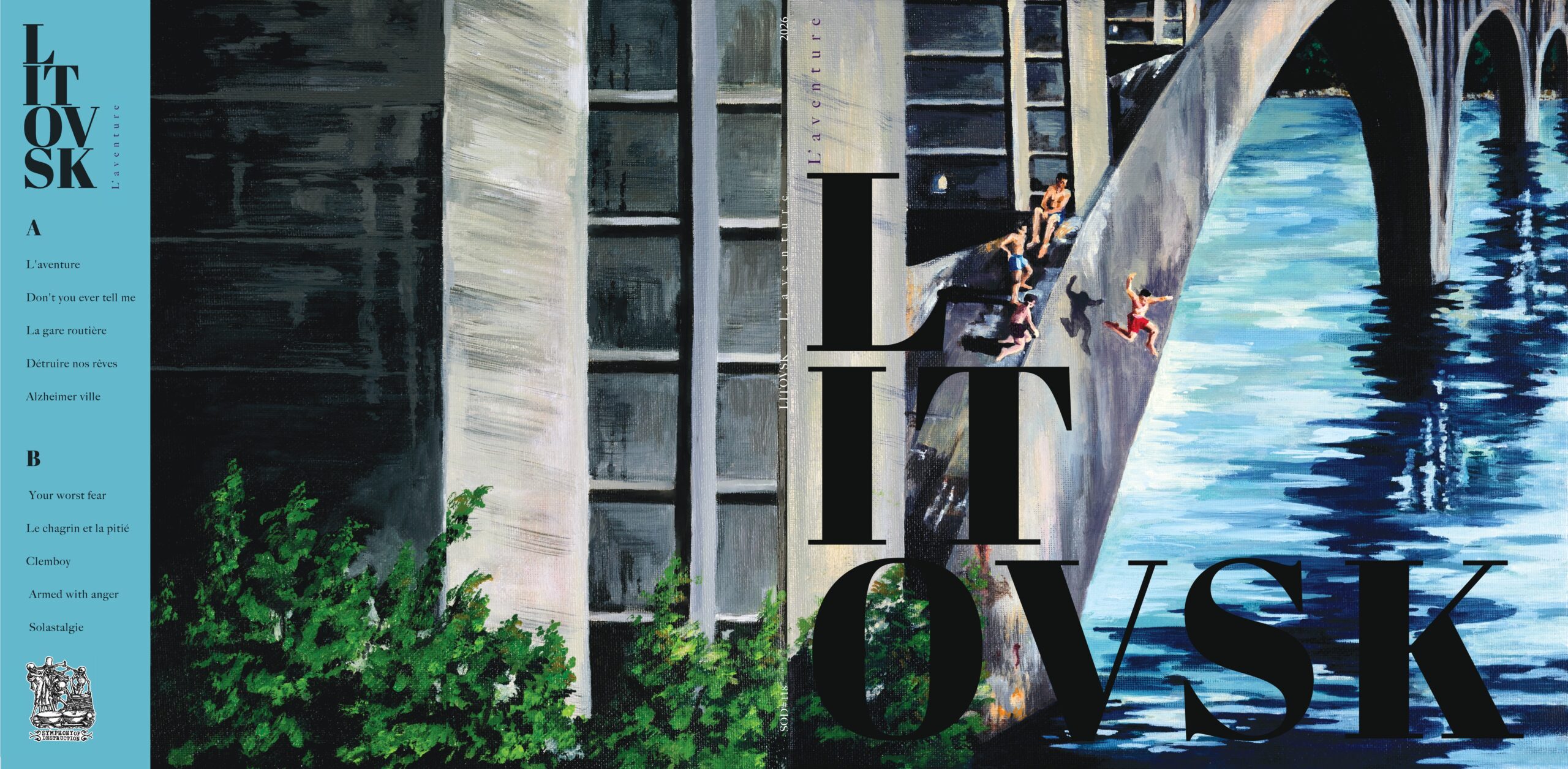
In the opening title track of your new album, “L’Aventure,” you sing that what you miss isn’t so much the past as the future you once imagined. What did that future look like, and what does “adventure” mean to you now? Are there any philosophical or literary references on the album, as there were on your previous releases?
Manu: I can’t answer the first part of the question because those are Damou’s lyrics, haha. But, for instance, I made a reference to Shelley and his poem “The Mask of Anarchy,” quoting and adapting the line “like lions after slumber” in “Armed with Anger.” There are surely other references hidden somewhere, haha.
Damou: The starting point for this song is the rather common feeling of a disconnection between my youthful hopes and the reality of being in my thirties. I think that as teenagers, we imagine the future will inevitably be better. Even if the political, social, or environmental situation is getting worse, we tell ourselves that at least from a personal standpoint, things will definitely get better.
For me, turning 18 meant escaping the boredom of my small-town life, breaking free from my parents, finishing high school, and finally doing something truly interesting. And then getting involved in politics—and why not start a band… In short, living my life.
By the time I hit my thirties, I felt like it had all gone by way too fast. And above all, that my present life had turned out to be pretty dull compared to my youthful dreams. So the idea behind the song isn’t so much to say “things were better back then”: I have absolutely no regrets about the weekends of my youth, doing nothing with my friends. It’s more about realizing that, despite everything, we’ve settled into life and ended up getting bored all over again.
And so, in this daily life that isn’t always much fun, we look for excitement wherever we can. I think that today, true adventure no longer exists. All we have left is to explore the ruins of capitalism. The kind of adventure this song talks about is “the poor man’s adventure.” For some, it means fighting for their football team every weekend. For me, it was exploring the city, its outskirts, and leaving my mark there. Today, it would be more about paying attention to the biodiversity that’s disappearing…
In any case, the album cover painted by our friend Marine Summercity perfectly captures my idea of adventure: a group of young people jumping off the old concrete bridge that connects Brest to the city of Plougastel—which is, of course, forbidden—in the incredible setting of Brest Harbor.
As for philosophical and literary references, yes, there are still some. Since I have no imagination, I have no choice but to find ideas somewhere.
The last track, “Solastalgie,” evokes André and Dorine Gorz. André Gorz was a thinker I like: he is one of the founders of political ecology in France. Toward the end of his life, he wrote Lettre à D., a beautiful text for his wife, Dorine, who was suffering from an incurable illness. They chose to take their own lives together in 2007. They haunt our present, a time of heat waves, pesticides, and ecocidal projects.
Brest has a reputation as a gray, rainy city, rebuilt after being devastated during World War II. The city feels present in the new songs too, especially “La gare routière” and “Alzheimer ville.” What changes in Brest made you want to write these songs? You’ve also sung in Dutch in the past, but this album is entirely in French and English. How did the lyrics come together, and how do you decide which language to use for each song?
Manu: I won’t answer for those songs about Brest, as they’re Damou’s songs. But people may not know that we have two singers: Damou, who sings in French and a bit in Dutch, and me, in English. Now it’s even more confusing because I sing in French on two songs on this album, “Clemboy” and “Détruire nos rêves,” haha.
When Mitch and Clair send us the songs, we choose between us who’ll sing which ones and check that the other is okay with that. On the compilation Quelques coups d’éclats, we managed to do a song where we all sing, the six of us, and we’re really happy with the result. I’d really like to do more songs like that.
For my part, I chose to sing in French on these two songs because their subjects were intimate or close to our history in Brest, and it would have been weird to sing them in English. “Clemboy” is about our friend Clément, who was killed by fascists in Paris in 2013, and “Détruire nos rêves” is about the eviction of the L’Avenir squat, which was an important place for us in Brest.
Damou: The idea for “Alzheimer ville” undoubtedly came from the demolition of L’Avenir, a self-managed community center built by the residents of our Saint-Martin neighborhood.
I borrowed the title from our friend Marine Summercity—her again. A few years ago, she drew pictures of new “luxury” apartment buildings constructed in place of old ones, with the slogan “Alzheimer City.” I really like that idea of a city that forgets its own past.
In fact, 80% of Brest was destroyed by British and American bombing raids during World War II. Since then, Brest’s rich people have had a real problem with their city’s history. First, they did everything they could to erase the nostalgia for “Old Brest.” And now they’re targeting many buildings constructed before the war or in the 1950s. Instead of renovating places, working with what already exists, respecting the residents’ experiences and the memory of these places, the city government is tearing them down.
This has been particularly true over the past decade or so, during which we’ve seen a real coarsening of urban planning. In fact, most of the places I loved in this city have been destroyed by real estate projects.
The goal of all this is to change Brest’s image, to make it an attractive city for investors and the bourgeoisie. And it’s working to some extent: the city looks clean, rents have already risen significantly, and there are more and more assholes driving Teslas. In short, Brest is becoming just another city…
As for the language, it was Clair, our bassist, who suggested that I sing in Dutch when we formed the band, since I’m a Dutch speaker on my father’s side. Now I prefer to write in French. It’s more difficult, but since it’s my native language, it allows me to be a little more subtle.
“Le chagrin et la pitié” names Resistance fighters alongside collaborators and fascist groups in Brittany. What drew you to this history, and what do you feel is being forgotten or deliberately brushed aside? I’ve always had a positive impression of Breton identity, language, folk music, and cultural heritage. How do you relate to these things, and is there also a darker, nationalist side that people outside Brittany might be less aware of?
Manu: Again, it’s one of Damou’s songs, haha, so I’ll skip the first part of the question. I’m rooted in some elements of Breton “identity.” My mother speaks Breton, and I take Breton classes, so yeah, Breton culture is really important to me. I listen to a lot of Breton music and enjoy going to fest-noz, even if I don’t know how to dance like I did when I was a kid.
But yes, there was a darker side to the independence and nationalist movements, with conservative and fascist politics during some periods of their history. Nowadays, the cultural and political movements for Breton independence are really left-wing, but before and after the Second World War, that wasn’t the case at all. The shift toward left-wing ideas happened in the late ’60s. I think May ’68 helped.
What I’m saying here is a bit of a caricature. There were also people advocating for the Breton language before and after WWII who weren’t right-wing, but it gives you a rough idea of the situation! I can’t sum up the whole history here.
Damou: “Le chagrin et la pitié” evokes memories of my grandparents, who were children during the German occupation of Brittany. My grandfather was a communist and a labor activist. It was very important to him to pass on the story of the young Resistance fighters from his village who were tortured and shot by the Nazis. This song is a way of telling “the big story” through the small ones—those memories of the Occupation that every family carries.
With the passing of the last generation that experienced Nazi atrocities and the Holocaust, the issue of preserving those memories has indeed become pressing. I wrote this song against the backdrop of the rise of far-right groups, including in Brittany, where we had been largely spared until now.
A few years ago, a group of neo-Nazis adopted the name of the Breton National Party (PNB), a party whose members collaborated with the Nazis during the Occupation. Their knowledge of the Breton language, for example, enabled them to assist the Germans in hunting down Resistance fighters in the Breton maquis.
This song is also meant to remind us that, today just as in the past, fascists are scumbags. There’s no debate about that.
And indeed, regarding the second part of your question, that past has left its mark on Brittany, so much so that in the postwar period, it wasn’t that easy to advocate for the preservation of the Breton language or culture. It wasn’t until the folk revival of the 1970s that the Breton movement became firmly rooted on the left.
This history—like the history of Brittany in general, for that matter—is largely unknown to most people nowadays. Bretons have a lot of misconceptions about their own history, and I think that’s a problem.
So this song isn’t meant to reignite old arguments: I’m learning the Breton language, and I’m interested in this very rich culture. But I’m convinced that it’s essential to know the past in order to know where we want to go.
Litovsk, like Syndrome 81, often gets associated with the Oi! scene. Is that something that annoys you? Do you get asked about French Oi! a lot, and why do you think it has become so popular in recent years?
Manu: Haha, I was waiting for the Oi! question. As I say all the time, we’ve liked Oi! since our teenage days. When I arrived in Brest in 2008, we used to listen to a lot of Cockney Rejects, Blitz, Red Alert, The Oppressed, Camera Silens, Wunderbach—which is punk to me—and a lot of antifascist Spanish Oi! like Opció K-95 and Kaos Urbano, or Italian Oi! like Nabat and Klasse Kriminale. From France, there were Brigada Flores Magon, Bolchoi, Brixton Cats…
In those days, Oi! wasn’t really popular in the punk scene, but there was a strong crew of redskins and punks who liked Oi! in Brest. With bands like Viande Rouge and Jeunes Seigneurs, we had our local heroes. It annoys us because, to us, Litovsk isn’t Oi! We have some influences from the second era of Blitz, Red Alert, Cockney Rejects, etc., but we’re not an Oi! band!
We like that music, but we don’t identify as skinheads—well, not anymore for some of us, haha—or with that French Oi! revival. If you want my point of view on the French Oi! hype, it’s well summarized in a text I wrote for Maximum Rocknroll.
People tend to ask us lots of questions about French Oi! or cold Oi!, but most of the time we laugh a bit about it. We think maybe people are disappointed when they see us because we’re not skinheads or because we don’t like this “cold Oi!” hype. I mean, there are some cool bands out there, but the hype is shit, especially when it gives a new audience to shit old bands with shit ideas that we should let rot in the bins of history.

Maybe I should have asked this earlier, but we’ve been seeing footage of young people protesting and clashing with police across France. Behind those images are demands around education, public spending, and the future young people can expect, yet much of the commentary seems more interested in blaming immigrants or attacking Palestine solidarity. What have you observed yourselves, and what do you think gets lost in the coverage?
Manu: Big question, as it’s an ongoing movement. All I can say is that, to get a better picture of what’s going on here, you can’t just watch videos on YouTube.
Basically, there was a social movement in secondary schools and universities for better study conditions. On October 17, that strong youth movement linked up with the rest of the French population who are pissed off with the social climate, gas and petrol prices—all the shit that’s happening here and across France.
And it all exploded. I can’t speak for Brest, but in Angers, where I live, those demos were massive, and people are fucking angry. People are ready to fight back, and that lifted my spirits. The local fascists have a meat shop, and their place got trashed with stones and eggs filled with shit. It was great to witness that!
I hope this movement will get bigger, but I fear the level of repression will slow things down a bit. We’ll see!
Some of my most-listened-to records this year include the demos from An Tec’h (who sing in Breton), Monde Moderne, Haro, Faucheuse (RIP Shiran), Cleancore Killer, Hinin, Mauvaise Mine, and so many other French bands. I still haven’t listened to the new Turquoise record, though. What French bands and records would you recommend, and what’s been exciting you lately?
Manu: Well, you mentioned most of them already, haha, but I would say Bemnoz, a new punk band from Brest (not that new, actually); Précipice from Nantes, who released a great album; Shadow Tides from Toulouse, with our guitar player Pablo; and Tanork, a death metal band singing in Breton with a cool attitude.
The new Turquoise is, for me, the best thing they’ve ever recorded. I really love that new EP. I like the multilingual singing; it reminded me of the legendary French band Heimatlos.
Clava is one of the greatest crust bands we’ve ever had in Brittany. A great live band. Gleetch from Rennes is really cool as well, in a garage punk vein. Columba Triste from Lille put out a great EP recently. There are so many good bands at the moment. Feu from Nantes is also great. I’ll stop here, haha.
Now that the new album is out, what are your plans for gigs and touring? I’ve seen you at some cool festivals in the past, and you’ve always had news about cool shows to share when we’ve written to each other. Tell me it’s still possible to book shows and tours without being on social media! How does that work for you, and is there anything else you’d like to add?
Manu: We’ll do a “release” party in Brest on February 6 if everything works out, and we’re working on a tour of Belgium and northern France for the following week. So people from Liège, Charleroi, Namur, etc., feel free to contact us at [email protected]. (Litovsk also have a simple website at litovsk.fr)
After that, we’ll see. Litovsk moves slowly because we’re all doing other stuff in our lives. Apart from the three who live in Brest, we’re all over the place, so we can’t accept every gig. We don’t like taking planes to do one-off gigs. We’ve done it about twice in ten years of existence, but we try to avoid it. Feel free to contact us, and sorry if we’re slow to answer!
Up the punx, and thank you for the interview!
Litovsk’s new album, L’Aventure, is available from Symphony of Destruction, along with a new EP from Grisaille (side project of Syndrome 81) and a mini-LP from Räkiä.


