ACAB
ACAB stands for “All Cops Are Bastards,” or the older British wording “All Coppers Are Bastards.” It is a deliberately confrontational anti-police slogan first documented in 20th-century Britain and later adopted in prison culture, graffiti, football crowds, punk and skinhead scenes, and political protest. Its numerical equivalent is 1312.
What Does ACAB Mean?
ACAB is an acronym for “All Cops Are Bastards.” In Britain, where the expression developed, it was traditionally expanded as “All Coppers Are Bastards.” Copper and cop are both informal words for a police officer.
In its political use, ACAB usually presents a structural criticism of policing rather than a claim that every officer has the same personality or commits the same acts. The argument is that every police officer participates in, enforces, and protects an institution viewed by the slogan’s users as coercive, violent, or unjust. Other people use the letters more loosely as an insult, an expression of anger after police violence, or general anti-authoritarian shorthand.
ACAB at a Glance
- Current expansion: All Cops Are Bastards.
- Older British wording: All Coppers Are Bastards.
- Numerical form: 1312.
- Common uses: Chants, graffiti, tattoos, patches, clothing, record artwork, and political slogans.
Where Did ACAB Come From?
The exact origin of ACAB is unknown. It is often associated with British working-class dissent, criminal slang, and prison culture, but it did not begin with punk. Lexicographer Eric Partridge recalled hearing the full phrase in the 1920s as part of a short street rhyme. The same line can be heard in We Are the Lambeth Boys, a documentary filmed in South London in 1958 and released in 1959.
A frequently repeated story says that striking British workers shortened the phrase to ACAB during the 1940s. That account has not been firmly documented and may be part of the slogan’s folklore. What can be established is that the full phrase circulated well before the punk era and that the acronym was established in British prison and street culture by the 1970s.
In 1970, the Daily Mirror ran “ACAB” as a headline in a story about a teenager who had embroidered the letters on his jacket after seeing them on a Hells Angel. The newspaper did not coin the acronym, but the publicity helped carry it into wider popular culture. A detailed history of ACAB also traces its appearance in British prison graffiti, tattoos, music, and protest.
What Does 1312 Mean?
1312 is the numerical form of ACAB. Each number represents a letter’s position in the English alphabet:
1 = A 3 = C 1 = A 2 = B
It carries the same anti-police meaning as ACAB and is commonly used in graffiti, tattoos, patches, usernames, and record artwork. The number is a compact code, not a separate slogan.
Expressions such as “All Cats Are Beautiful” and “Always Carry a Bible” are later backronyms: alternative phrases created to fit the existing letters. They may be used as jokes, evasive explanations, or playful references, but they are not the acronym’s historical origin.
ACAB in Punk & Skinhead Culture
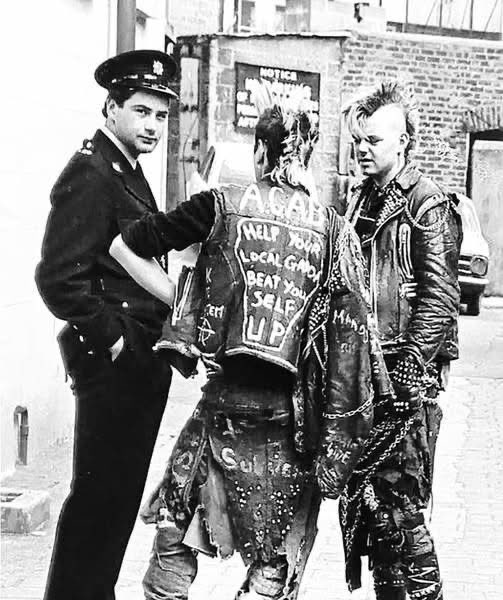
ACAB became deeply embedded in punk and skinhead culture during the late 1970s and early 1980s. Its blunt hostility toward police authority suited street punk and Oi!, while its brevity made it ideal for choruses, leather jackets, badges, tattoos, and graffiti.
The best-known punk use is “A.C.A.B.” by London Oi! band The 4-Skins. A live recording appeared on the band’s 1982 debut album, The Good, The Bad & The 4-Skins. Germany’s Slime had already released a different song titled “A.C.A.B.” on their 1981 debut, Slime I. These songs helped transform a British street and prison abbreviation into an international punk slogan.
ACAB in Punk Music
- Slime: “A.C.A.B.” from Slime I (1981).
- The 4-Skins: “A.C.A.B.” from The Good, The Bad & The 4-Skins (1982).
- The Casualties: “1312” from Written in Blood (2018).
From Oi! and street punk, the slogan spread through anarcho-punk, hardcore punk, crust, football supporter culture, and anti-authoritarian movements around the world. It remains one of punk’s most recognizable four-letter statements.
Is ACAB a Left-Wing or Right-Wing Slogan?
ACAB expresses opposition to police, but those four letters do not describe a complete political ideology. The slogan is strongly associated with anarchists, anti-authoritarians, anti-fascists, police-abolition activists, and protests against police violence. It has also circulated among football hooligans and racist skinheads whose politics are entirely different.
Non-racist skinheads, including SHARP, traditional, and left-wing skins, use ACAB, and so do some fascist boneheads. The Anti-Defamation League’s entry on ACAB therefore stresses that the acronym must be judged in context. Nearby symbols, lyrics, affiliations, and behavior reveal far more than ACAB alone.
Its international visibility expanded again during the 2020 protests following the police murder of George Floyd. In that setting, ACAB was generally used as a critique of police violence, racism, and the institution of policing rather than as a skinhead identifier.
A.C.A.B., the Malaysian Oi! Band
A.C.A.B. is also the name of a pioneering Malaysian Oi! band formed in Kuala Lumpur in 1994. The group helped establish what it called Eastern Oi! and became one of the best-known Malaysian bands in the international skinhead and street punk underground.


