Manual de Combate: We Can Seek the Greatest Possible Creative Freedom by Daring to Sound Different
Experimental punk quartet from Santiago de Chile talks about their new record and political reality in their country.
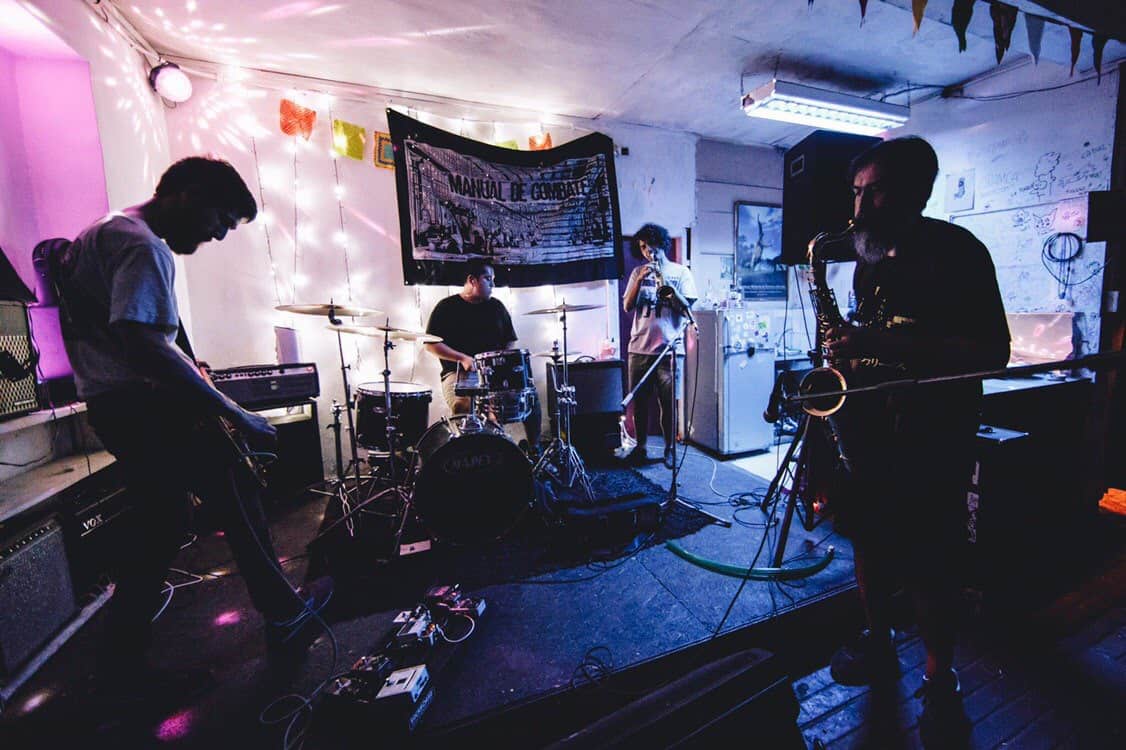
Mapas Auténticos del Mundo Imaginario, Mapas Imaginarios del Mundo Real is the new album by the experimental punk quartet Manual de Combate from Santiago, Chile. After releasing the single Aparcoa in December 2019—a long track full of mood swings, dynamic, energy and a creative proposal of mixing various musical genres—they come back with a great full length where they explore many more themes and musical territories. Six tracks and almost 40 minutes of new ways of proposing what punk can be await anyone who dares to listen to their experimental sound.
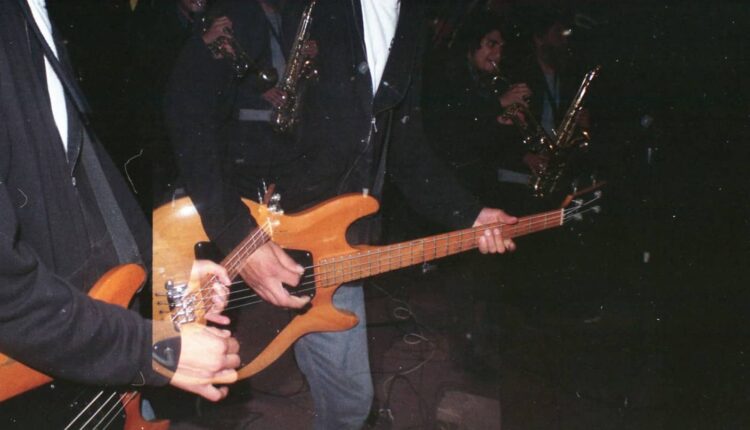
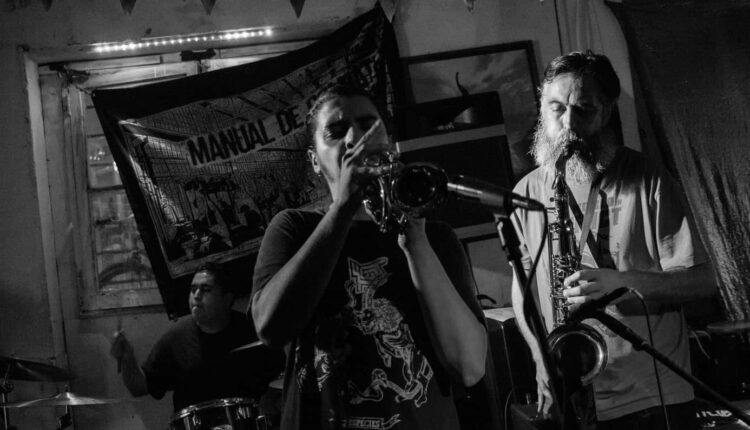
Manual de Combate started out as a duo with a strong and wide bass and versatile drums, later adding a brass section to make their sound even harder. They release their music on their own label, Imperecedero Discos, and have been incredibly active, touring and playing all over Chile.
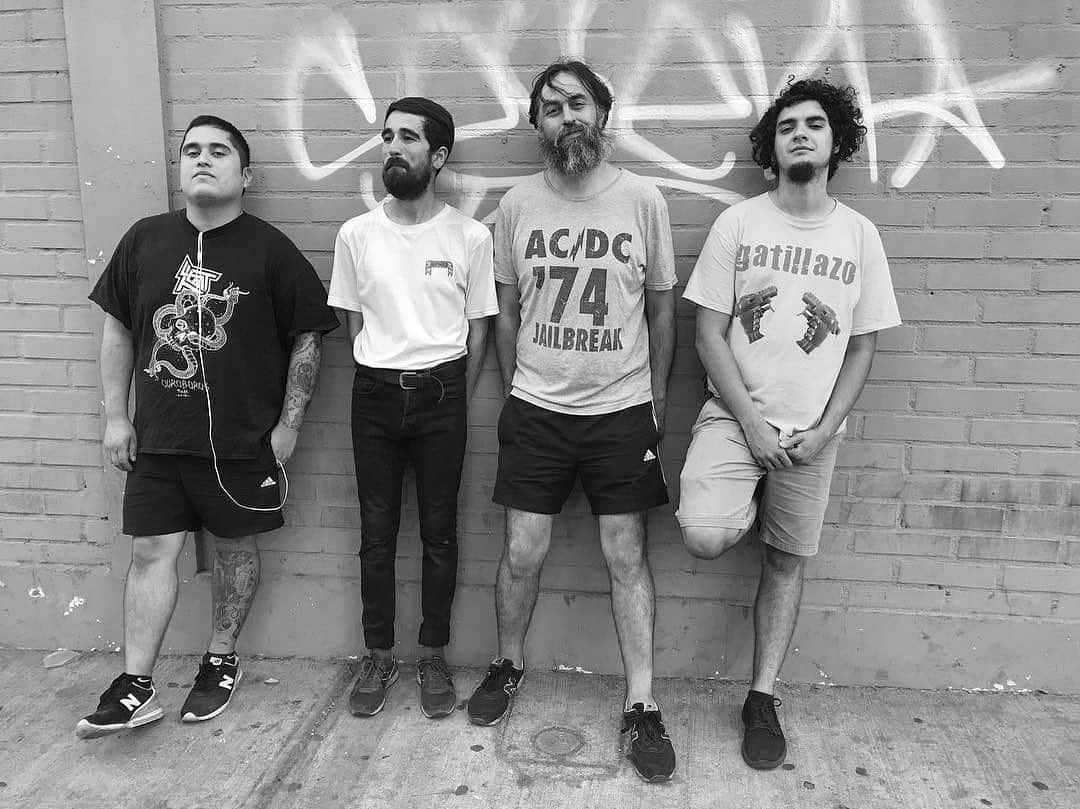
We contacted them to talk about this new LP, their history and the current political situation in Chile.
The following interview was recorded in Spanish and then translated into English, we’re sorry if it’s not grammatically correct as we’re trying to keep the original expressions as much as possible.
How did Manual de Combate start and where did you get your origins?
Julio: I don’t know how it started… I joined the band a few years later. The band was recommended to me through their performances on YouTube and the web. Suddenly Gaspar wrote me to meet and see how we could add the saxophone.
I knew it was a punk band. But for me, punk isn’t just a way of making music, it’s a movement for social liberation that’s broader and more complex than that, it’s both aesthetic and political. I’ve considered myself a punk rocker since I was 20, and I’m almost 50 now, and I still consider myself a punk rocker. But I’m not limited by that, quite the opposite. That’s where my roots are.
Gaspar: First of all, thank you for having us and for your time. Manual de Combate was born at the end of 2015, with the release of the EP Asociación por el retraso del tiempo in March 2016.
We all come from different projects that used punk as a language and were built on a DIY ethic, with very intense activities in terms of music releases, publications, shows, etc. That is our most direct relationship to punk, and also to our way of understanding it. It has to do with the way of doing things and always questioning our current commercial system through concepts like self-management and mutual aid.
The band has grown a lot and the sound has changed, but the essence seems to stay the same?
Julio: I think the “essence” is the interplay between bass and drums, and we remain true to that to this day. The horn section lives with it… almost like a Marxist figure of base and superstructure (laughs).
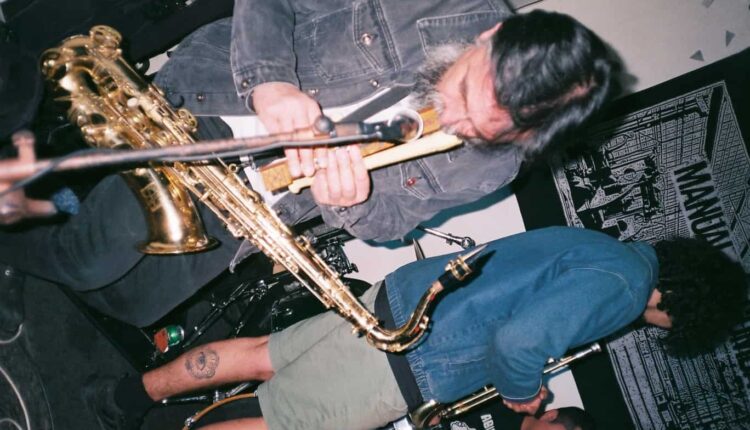
Also, while the base is more influenced by different kinds of hardcore styles, with the horn section we show our deep love for free jazz, which besides being a subversive kind of music, was very influential when punk started, even if nobody talks about it much (for example, the influence of Coltrane / Ayler in Velvet Underground, Stooges or MC5).
The sum of all this is what makes up the current sound of Manual de Combate as a quartet.
Gaspar: Yeah, I think it has to do with circumstances, the friction, the street or life itself, in the sense of the connections we’ve made or how the project has changed until now. It all has been a very gradual process where one thing lead to the other. It’s very fun that it is like that and I think this essence can be seen in such a deconstructed manner. Not only in the musical sense, but also as a collective, a group of human beings or related people.
How was the new album made?
Julio: Since I joined the band in January or February 2019, the songs started coming to us. We immediately started working on this record, besides the people who taught me the old songs.
We moved out of the rehearsal room we were in because of some dangerous things that were happening at the time, and we continued with the shows and mini-tours to the coast and the south of Chile until we had enough material for a new album and we started recording it in the same rehearsal room. Then Gaspar sent the recordings to Nahuel in Buenos Aires (Estudios del Valle) and Milo Gomberoff in Barcelona (Estudio Hukot) and that was it: a new album.
Gaspar: It’s always been very important to us that we feel comfortable and ready to play by the time we record. As Julio says, besides the rehearsal routine, we had the chance to try out and tour with the new tracks, and from there, with all the experience of that year, we locked ourselves in Casa Brasil to record it live. Throughout the whole process, it was fundamental to have the help of Nahuel and Milo, who knew how to support us and collaborate in the mixing and mastering, respectively.

What are the most notorious changes to your sound you see in this new release?
Julio: More than anything, I think we have strong political positions: we are anti-capitalist and anti-authoritarian. We stand for anarcho-communism. That doesn’t change.
What’s interesting is to see how the music we make expresses the social and individual contradictions in which this world lives, and how we can show from our punk roots that we are not obliged to repeat what has already been done, nor to be encapsulated in formal styles and too well-known subgenres of punk. We can seek the greatest possible creative freedom by daring to sound different, or better, to sound like only the four of us can at this moment.
Gaspar: Musically speaking, I can add that this creative freedom led us to work on songs like “Aparcoa”, a kind of catharsis in 14 minutes that on a collective level filled us with satisfaction in how it ended and how irreducible it is: you don’t know if it’s punk, noise, rock, free jazz, post-rock or any of those terms that the ‘specialized’ press likes to use.
Is there an overarching theme that runs through all of the band’s work?
Gaspar: I think there are topics and/or constructs that are repeated in the lyrics. The imaginary constructs and our commodified relationship with time and space, the relationships we have with territory, and quotes or references to various texts that we think are relevant.
How does the graphic imagery of Manual de Combate appear in this process?
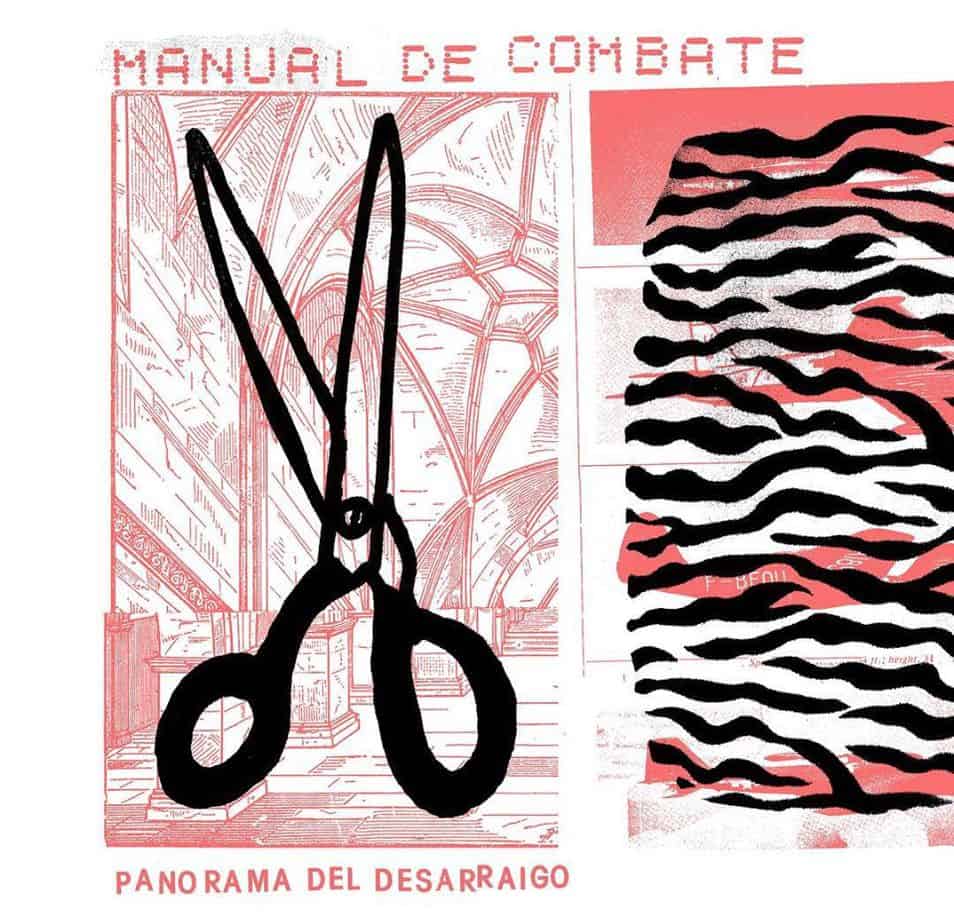
Julio: I can’t say much about it, but we have close ties with comrades who are designers and who have helped us in this area because they know us and understand our aesthetics.
Gaspar: It has to do with the collaboration with different partners who have been able to interpret or have been involved in some way in what we do, including the artwork of the albums, posters or the development of concepts.
In this regard, the help of Nico Sagredo, Katafú, Caro Lagos, Joaquín Contreras, Tomás Spicolli and Victor Jaque has been very valuable, in the sense of generating or sharing the community we’ve created from the same intuition and creative passion.
How’s the political discourse in the places you play and related to the scene?
Julio: There is a strong antifascist, animal liberation and feminist presence. I miss a more integral revolutionary position, for communism and anarchy, but, well, we live in a postmodern era.
Gaspar: I think it’s great and I love the fact that out of an anti-capitalist conscience there’s been a lot of activity around the political: from zines to solidarity activities to help the prisoners of the current uprising in Chile, to help buy medical supplies and directly support any of the fronts that are against the system. I think this is the best we’ve seen in the hardcore punk scene in years.

You’ve played in a lot of different places. What have you learned and built from these experiences?
Julio: I’ve never toured outside of Chile. Los Ángeles was a really great concert and I also liked Temuco and Valdivia. In September we did a mini tour in Punta Arenas, which was a very important show for me because I lived there in the ’80s and it is one of the most southern cities in the world. There we were able to play in a social libertarian center in the Población 18 de Septiembre, a very militant place since the time of the rebellion against Pinochet.
During the tour we learned that we exist and create thanks to a great chain of mutual support.
Gaspar: The most important thing, I think, has been being able to build relationships with partners and comrades in different parts of the world who like us and are able to do each of their projects from the most honest side of the DIY spectrum.
All of this has brought us an incredible level of knowledge that we could hardly have without our connections to noise.
How do you feel about the current social process in Chile and how do you manage to live with it?
Julio: We all participated with enthusiasm since the first day. It was something we had been waiting for for years, and suddenly it happened.
As a band, we played a lot less in the beginning, but we were looking for a way to do shows and compilations to support the prisoners and people wounded in the uprising.
Gaspar: I think changes are also occurring on an individual level, from the question of how to meet our basic needs at meetings, to the way we organize, to the way or context in which we participate.
Participation on a relational, personal, and professional level, and on any front that has been possible, has been very important and will continue to be as we continue to struggle.
How can music support or be understood in such a context?
Julio: The anger that exists in our music comes from that particular political context. With the quieter and more spiritual pieces, we are trying to reach somewhere beyond: the utopia, the world that we have within us and that we can only give birth to through acts of individual and/or collective revolt.
It is not about “artists” trying to “support” the revolt, it is about being part of it as the integral human beings we are.
Gaspar: Music is a social fact in itself and another front where we can build, do and make a new world possible.
Is there anything else you would like to add to end this interview?
Julio: The Chilean uprising is not over yet! We think it’s just beginning and we will continue to deepen it with everything we have in our hands: stones, barricades, meetings, saxophones, posters, everything that works for the struggle of humanity against the forces of domination.
Gaspar: Thanks a lot for the space, time and support. Please keep writing about screamo from the 2000s.
You can contact Manual de Combate at [email protected].The album is available on Bandcamp (and other streaming platforms) and can be listened and downloaded for free.


