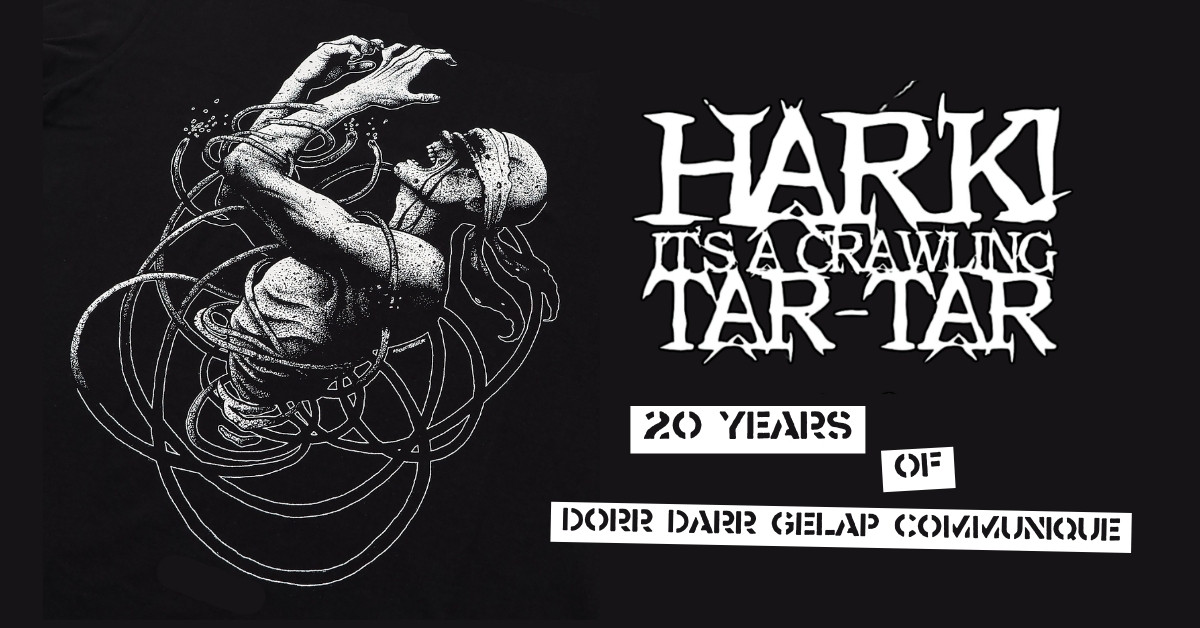
Hark! It’s a Crawling Tar-Tar: 20 Years of Dorr Darr Gelap Communiqué
A look back at one of the most interesting releases in Indonesian hardcore punk history.
Hardcore punk had already taken root in Indonesia by the early 1990s. The final years of Suharto’s New Order regime were marked by widening economic inequality, political repression, and growing frustration among young people. In cities like Jakarta, Yogyakarta, and especially Bandung in West Java, punk scenes became one of the outlets through which that frustration could be voiced. Bands, zines, tape trading, and small shows created informal structures where music and political ideas circulated together.
When the Asian financial crisis hit in 1997 and protests against the regime intensified, many of these underground spaces became closely connected with student movements and oppositional politics. By the time Suharto resigned in 1998, during the period now known as Reformasi, punk had already become part of a broader culture of political dissent and grassroots street-level organizing.
Bandung quickly became one of the key centers of this activity. The city had long been associated with youth culture, art schools, and a relatively open cultural atmosphere compared with other Indonesian urban centers. By the late 1990s and early 2000s, Bandung’s punk and hardcore scenes were supported by a growing web of distros, rehearsal spaces, and small DIY businesses producing (often bootleg) tapes, records, shirts, and patches.
These places functioned as vital meeting points where bands, activists, and listeners exchanged music, ideas, and information. They also helped create an alternative economic base that allowed underground culture to survive outside both government structures and the mainstream music industry, a practical extension of punk’s DIY philosophy adapted to the economic and social realities of the archipelago.
This network also connected the Bandung scene with the wider international punk underground. One clear influence on Bandung hardcore in the early 2000s came from US bands like Tragedy and From Ashes Rise. Their sound combined galloping d-beats with melodic guitar leads and a darker, almost epic emotional tone. Indonesian bands absorbed that style enthusiastically and translated it into their own context.
And within this environment, one of the most significant records to come out of the Bandung underground took shape in 2006. Before settling on the name by which the band is now remembered, early rehearsals reportedly took place under the name Tuberkulosis. The band later changed its name to Hark! It’s A Living Tar-Tar before eventually landing on the equally strange Hark! It’s A Crawling Tar-Tar.
Hark! formed from the remains of several Bandung hardcore bands, most notably Domestik Doktrin. Two of the key members, vocalist Ari Ernesto and drummer Kenteror, had previously played in Domestik Doktrin before starting Hark. The lineup eventually solidified with Ari on vocals, Vincencius (aka Dede) and Billy on guitars, Uep on bass, and Kenteror (aka Kenji) on drums.
Hark! It’s A Crawling Tar-Tar was also connected to the Balkot Collective (aka Kolektif Balai Kota, or “Reclaim The Stairs”), a DIY collective active in Bandung in the early 2000s that brought together musicians, artists, and organizers from the local hardcore scene. Like many projects from that period, the band existed within a multitude of collaborations involving music, visual art, publishing, and organizing.
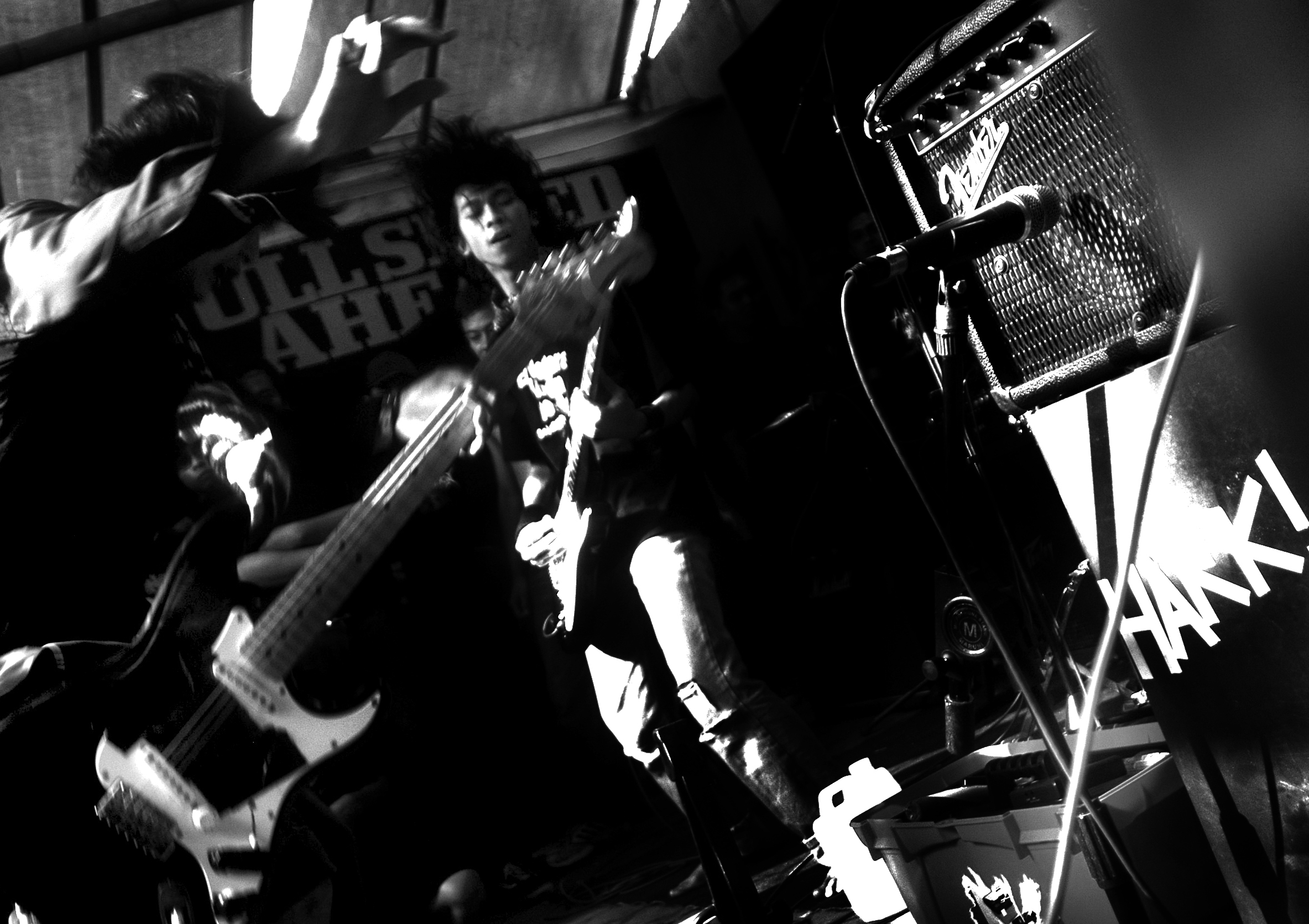
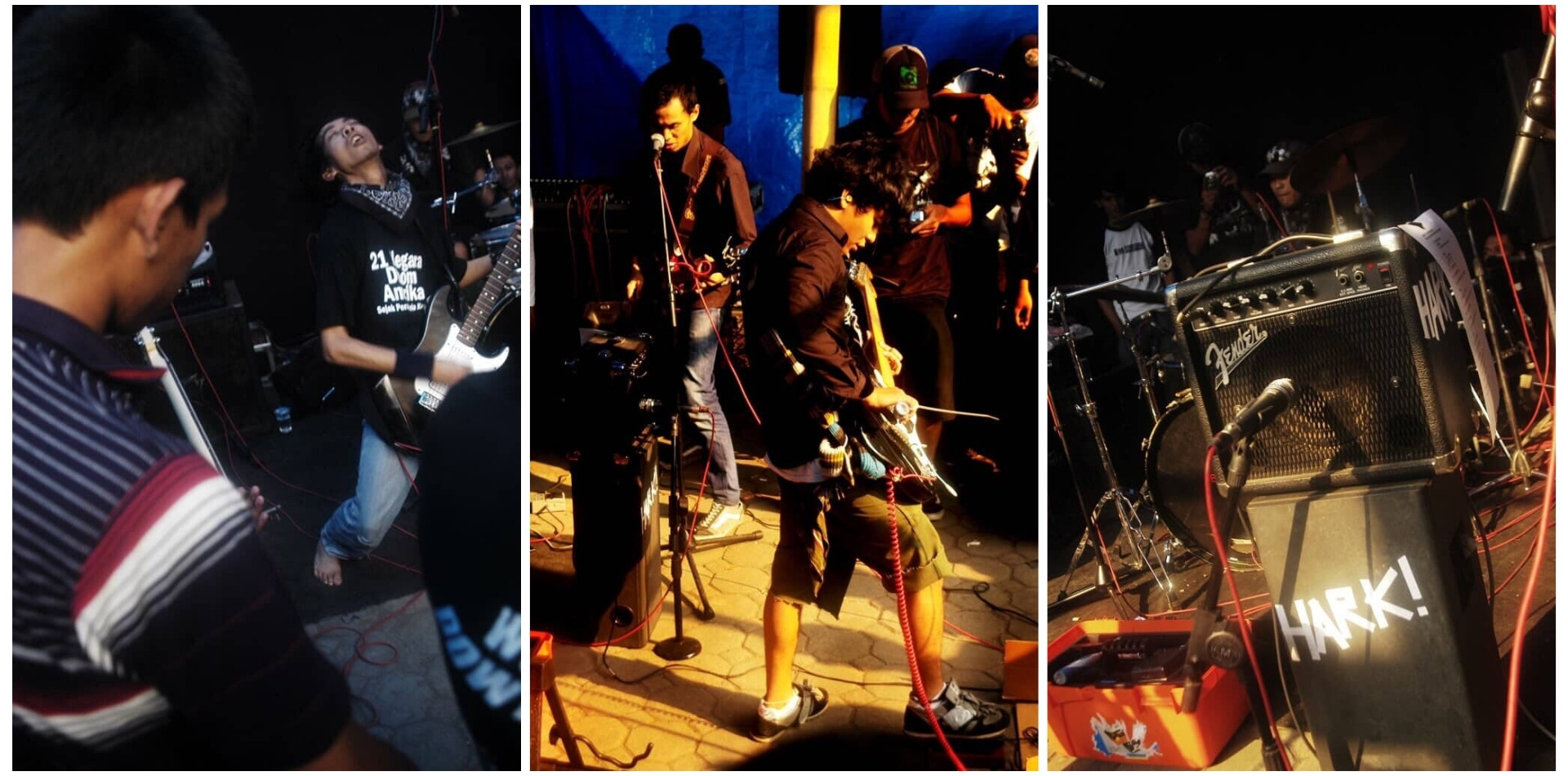
Due to the band’s short lifespan, Hark! It’s A Crawling Tar-Tar didn’t perform very often. In total they played fewer than five shows, most of them in Bandung under the Balkot Collective banner, and at least one appearance outside the city, like a New Year’s Eve show in Bekasi. Some of these performances took the form of small studio gigs, a format popularized by Balkot as a way to deal with the difficulty of finding venues for hardcore shows in the city while also keeping events affordable and autonomous.
One of their more visible performances took place at Ultimus, a leftist bookstore in Bandung, in June 2006. Earlier shows included a December 2005 show at IF Venue, a DIY cultural space managed by Frans Ari Prasetyo between 2004 and 2006 that hosted gigs, screenings, discussions, and exhibitions connected to the underground scene. Around the time of the album’s release in September 2006, the band also organized small studio gigs to promote Dorr Darr Gelap Communiqué, inviting mainly close friends and collaborators from the scene. Surviving gig posters from that period also document the band’s name transition, from Hark! It’s A Living Tar-Tar to Hark! It’s A Crawling Tar-Tar, with designs created by Billy and Kenteror.
Domestik Doktrin had already built a reputation for engaging with political theory and philosophical ideas more openly than most typical hardcore punk bands, and Hark pushed that message even further. Ari Ernesto wrote all of the band’s lyrics, drawing heavily from political writing, leftist academia, philosophy, and the kinds of texts circulating through Bandung’s zine culture at the time.
Hark! It’s A Crawling Tar-Tar’s entire recorded output consists of only a single album lasting a little over half an hour. Dorr Darr Gelap Communiqué was first released in 2006 on CD through the Singapore-based DIY label Thrash Steady Syndicate (TSS).
The release reflected the broader Southeast Asian DIY network that connected scenes across Indonesia, Singapore, and beyond. The connection grew partly out of earlier collaborations between the Bandung and Singapore scenes. One example was the Secret 7 Southeast Asia Tour CD released in 2005 through a collaboration between TSS and Inkoherent DIY Nutritionist Records, a Bandung label run by Frans Ari Prasetyo together with Ari Ernesto. Kenteror, Hark’s drummer, also designed the artwork for that record.
The economics of the original Dorr Darr Gelap Communiqué CD were very much in line with DIY ethics. Copies were sold for roughly one dollar, and instead of monetary royalties the band mainly received compensation through record trades rather than commercial transactions.
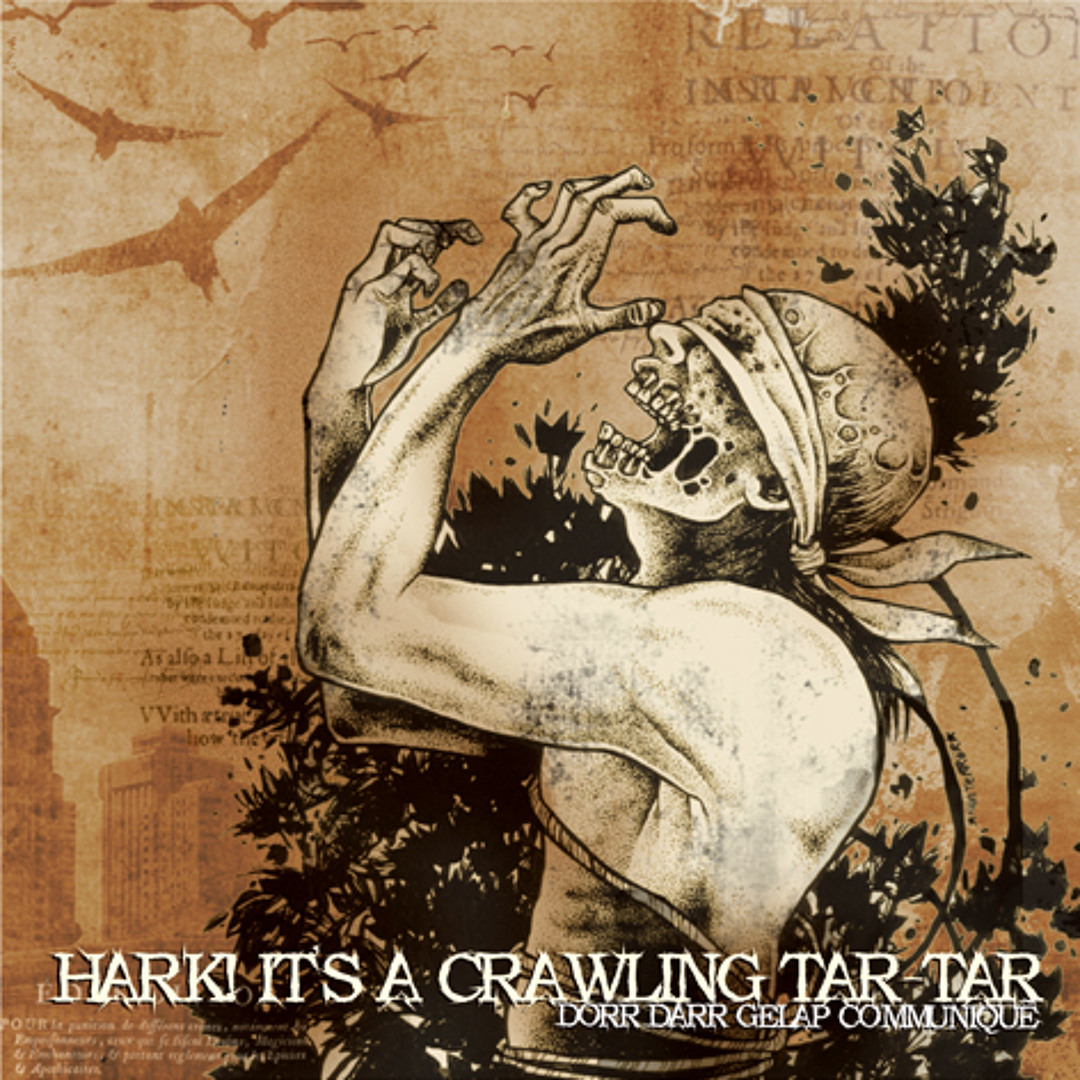
At first glance the record might seem like just another DIY artifact circulating through the Southeast Asian punk network. Over time, however, it became something far more influential. Among Indonesian punks, the album is often described as one of the key milestones of the Bandung hardcore scene in the 2000s.
Musically, the album moves between fast hardcore punk, ’90s metallic hardcore, and the darker, melodic tendencies associated with the early 2000s Portland crust scene. The guitar work at times clearly nods to bands like Tragedy and From Ashes Rise, especially in the way melodies unfold over driving rhythms and push beyond straightforward d-beat patterns. But Hark rarely settles into that space for long. The songs shift direction constantly, jumping from frantic bursts into unexpected passages that lean toward experimental hardcore. Memorable vocal patterns, big gang choruses, obscure samples, and occasional acoustic interludes all add to a sense of unpredictability that runs through the entire record.
What holds it together is the band’s ability to blend these elements without sounding forced. Crust and d-beat form the foundation, layered with darker melodic harmonies, Scandinavian-style riffing, and thrashcore intensity. The influence of bands like His Hero Is Gone, Anti-Cimex, Diskonto, Uranus, From Ashes Rise, and Tragedy is clear, but Hark never comes across as derivative. If anything, the closest Western comparison might be something like The Spectacle or Żegota, where similar ideas are pushed into more unconventional directions.
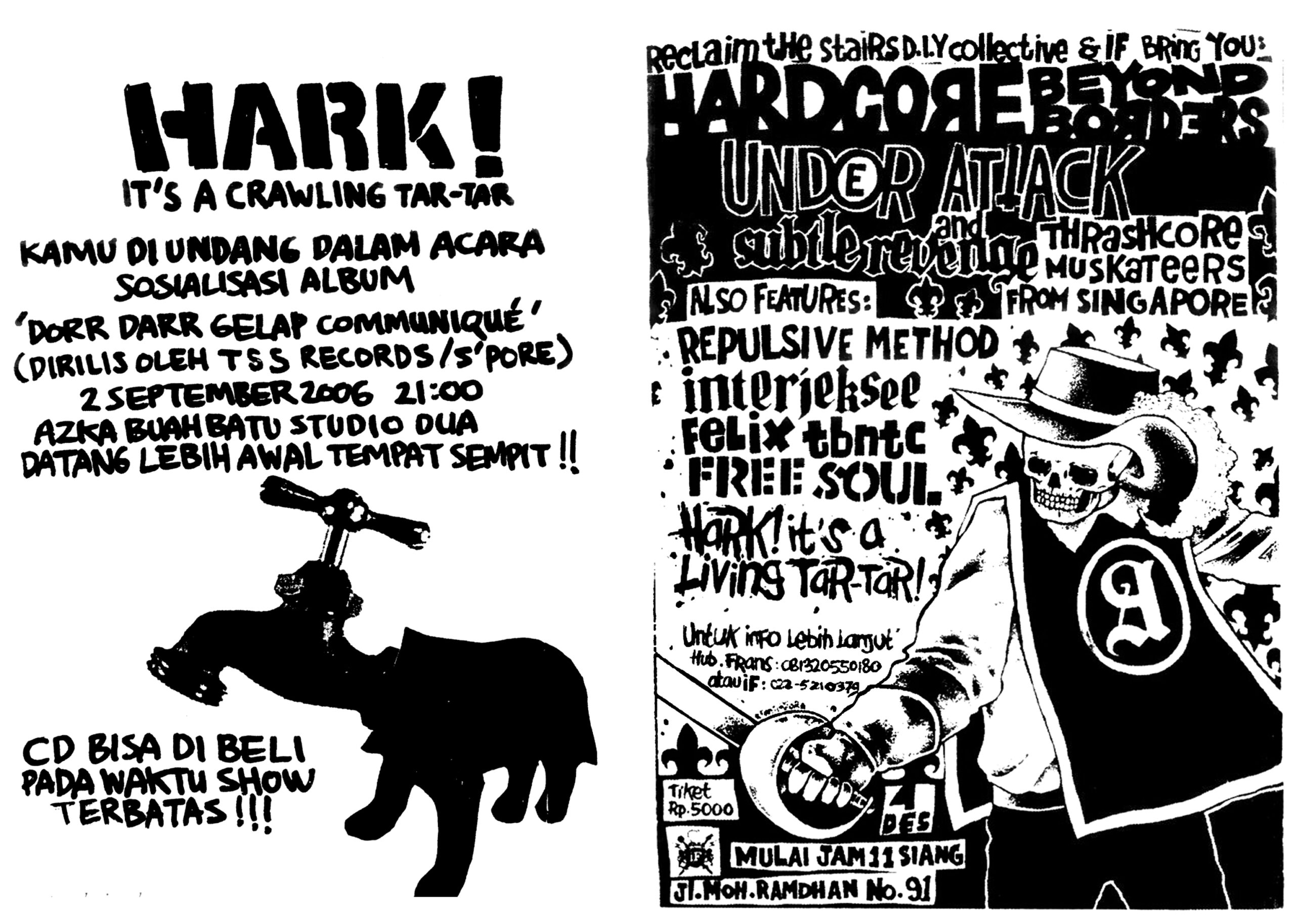
One thing that makes the record stand out is the language. All of the lyrics are written in Bahasa Indonesia, with occasional use of Sundanese, the local language of West Java. At a time when many hardcore bands in Asia preferred to write in English, this choice gave the record a more distinctive character. Lyrically, the songs draw on postmodern philosophy, anti-colonial anarchist critique, linguistic playfulness, and satire. Ari Ernesto’s approach pulls from a wide range of political and theoretical references, occasionally citing ideas associated with thinkers like Antonio Gramsci, Michel Foucault, and Audre Lorde, alongside the kinds of radical and anarchist texts circulating through punk zines and activist circles at the time. One of the most interesting tracks is “GramatikkallyOpressed,” whose title also remarks at the band’s fascination with language as a political structure. The song plays with spelling, grammar, and word formation while commenting on the power relations embedded in linguistic systems.
There’s even a song about tempeh, the fermented soybean staple of Indonesian cuisine. Within the album’s conceptual world, tempeh becomes a humorous but pointed symbol in a critique of multinational corporations and global economic domination. The band’s long, exaggerated song titles and playful word combinations also recall the spirit of early 2000s screamo and emoviolence scenes (Orchid, Ampere, etc.). In that sense, Hark! It’s A Crawling Tar-Tar shares a certain conceptual affinity with experimental hardcore bands where strange names and cryptic postmodernist lyrics form part of the artistic statement.
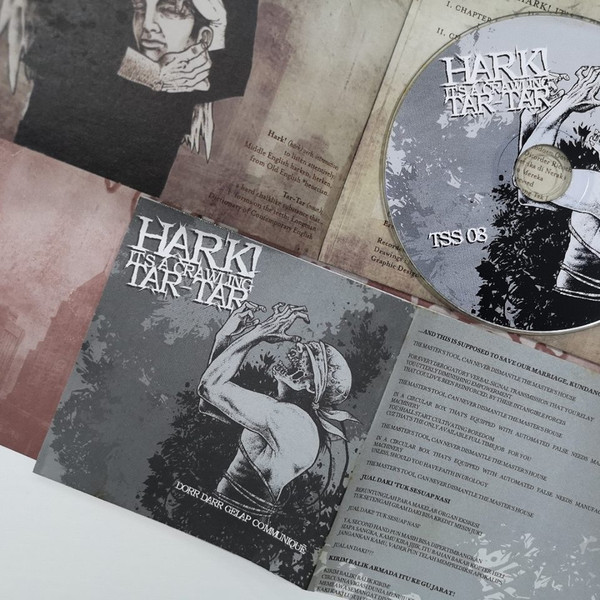
Visually, the band also carried the strong DIY aesthetic. All the artwork for the album and related materials was created by drummer Kenteror, who is still active as an illustrator within the Bandung scene.
Despite the ambition of the project, the band did not last long. Hark! It’s a Crawling Tar-Tar existed only briefly between 2006 and 2007. The breakup was largely due to practical circumstances. Members moved in different directions in life. Ari continued his studies in Europe, Billy worked in Bali, Vincencius found employment outside Bandung, Uep focused on building a photography business, and Kenteror became more active as a professional illustrator and artist. As for new bands, Kenteror formed Kontrasosial and Sunbath, and Vincencius later played with Ssslothhh.
At the same time, Hark’s members shared a common sense that they did not want their work to become trapped in the process of turning memories, DIY projects, and musical artifacts into scene commodities. For several years the album circulated quietly through trading and word of mouth. Then, in 2013, Hark resurfaced when Dorr Darr Gelap Communiqué was reissued on cassette by Disaster Records and Grimloc Records in Bandung, alongside another cassette edition released by Apa Adanya Records. The tapes sold out quickly and revealed that interest in the album had grown far beyond the small circle that originally knew it.
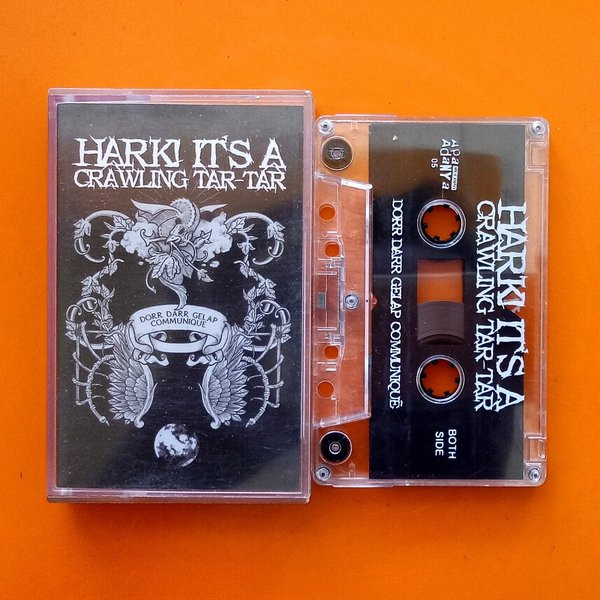
The renewed attention led to further reissues. In 2016 Grimloc Records and Disaster Records released the album on 12-inch vinyl in a limited pressing of 300 copies. Despite the relatively high price for Indonesian audiences, the vinyl sold out rapidly. Later editions followed, including CD reissues and merchandise such as posters and t-shirts.
The growing demand also sparked debate within parts of the scene. Some welcomed the renewed availability of an influential underground record, while others saw something more troubling in the way the album was being circulated. Part of that is due to broader changes in the economics of hardcore punk itself. Grimloc Records, for example, operates as a larger enterprise helping bands from Bandung across many genres, including punk, hardcore, metal, hip-hop, and folk, release their music. Disaster Records is connected to Maternal Clothing Company, a well-known Bandung fashion brand that produces merchandise and supports music releases. A record that originally circulated within a small DIY hub, sold for about a dollar and traded between friends, has gradually become part of a much larger punk economy.
In Frans Ari Prasetyo’s view, the increasing scarcity and rising prices of later pressings show how influential DIY releases, especially from obscure bands like Hark, can easily turn into objects of commodification and profit-driven interest once demand grows. As hardcore became more popular, a market inevitably formed around it, and different actors stepped in to occupy that space, in Indonesia and elsewhere. For many punks, the idea that a political hardcore record could later become the basis for collectible vinyl editions and a growing merch economy feels uncomfortable.
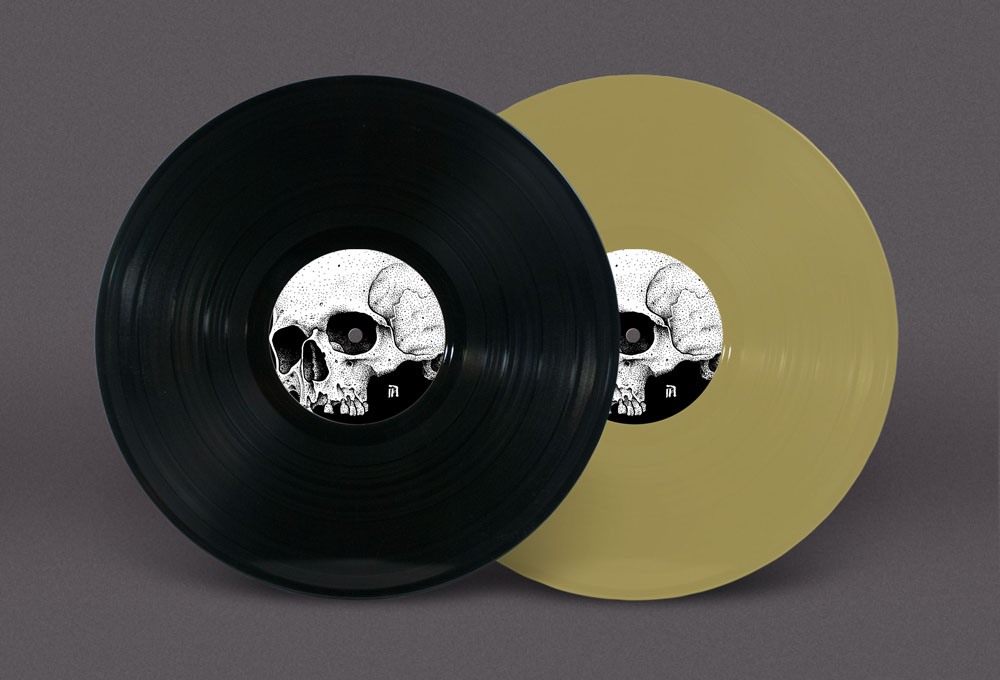
Listening to Dorr Darr Gelap Communiqué today, the album feels like one of the most genuine artifacts of a particular moment in the Bandung scene. The intersection of several forces that shaped Southeast Asia hardcore around 2000–2010; the political momentum that followed Reformasi, the growth of DIY distribution outlets, including the expanding merch economy, and the strong impact of international crust and d-beat scenes across the region.
Even today, despite the massive size of the Indonesian punk underground, many bands still operate under difficult conditions. Recording time, equipment, and distribution remain limited, and countless bands leave behind only demos or a single release. Hark! It’s A Crawling Tar-Tar recorded one album, disbanded soon after, and left behind one of the best and most distinctive records to appear from that scene.
Many thanks to Frans Ari Prasetyo for the invaluable help in tracing the history of the band and the wider Bandung hardcore scene. Frans works as an independent researcher with a particular interest in ethnography and the evolving socio-political dimensions of art, visual culture, urban movements, and subcultures.


